

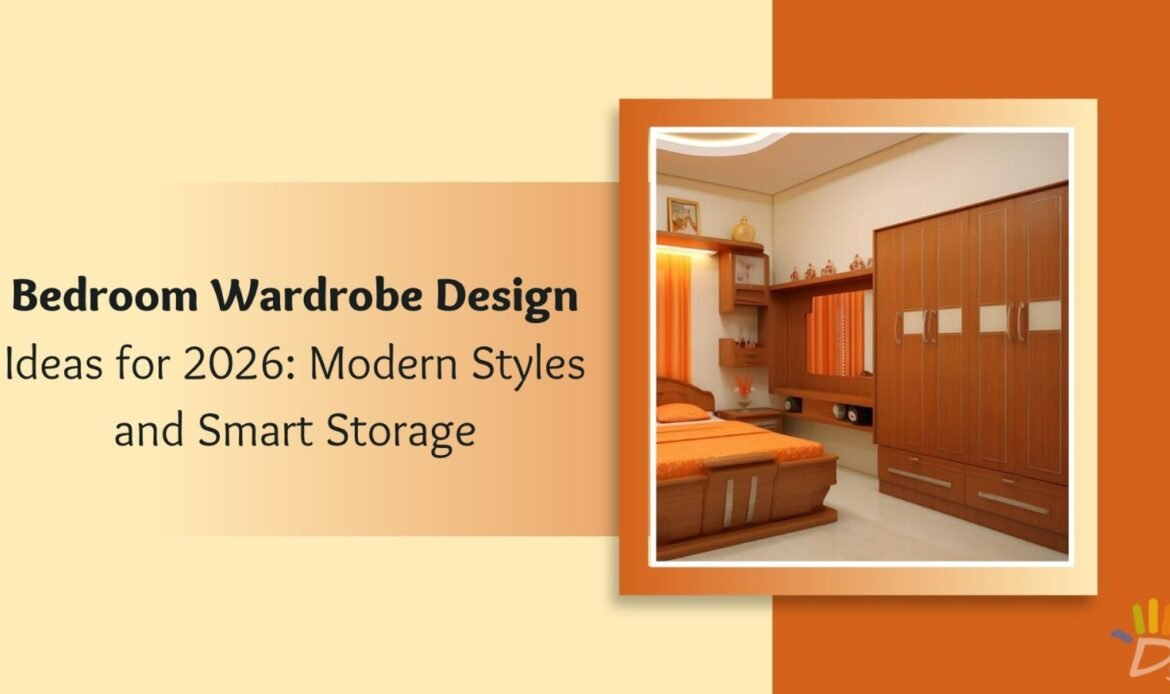
Bedroom Wardrobe Design Ideas for 2026: Modern Styles and Smart Storage
The wardrobe is the hardest-working piece of furniture in your bedroom, and often the most ignored.
We spend weeks choosing the right bed, the perfect curtains and the paint shade that feels just right. Then the wardrobe gets decided in a ten-minute conversation with the carpenter. Two doors, a loft on top, a mirror if you are lucky.
But think about how often you use it. Every morning when you get ready. Every evening when you change. Every weekend when you hunt for that one shirt you know you own. A badly planned wardrobe makes daily life a little harder. A well planned one quietly makes it easier, and makes your bedroom look better too.
If you are building a new home or refreshing your bedroom, this guide covers the best bedroom wardrobe design ideas for 2026. We will look at styles, materials, smart storage and the trends we are seeing in homes across Chennai.
What makes a good bedroom wardrobe design?
Before you look at finishes and colours, get the basics right. A good bedroom wardrobe design balances four things:
- Capacity. Does it hold everything you own today, with some room to grow?
- Access. Can you see and reach things easily, without pulling out three items to find one?
- Fit. Does it suit the room’s size, door positions, windows and walkways?
- Look. Does it match the style of your bedroom, or does it stick out like a separate piece?
Start by taking stock of what you own. Count your hanging clothes, folded clothes, sarees, shoes, bags, accessories and seasonal items like quilts and suitcases. A wardrobe for someone with forty sarees needs a very different inside from one for someone who mostly wears shirts and jeans.
Modern wardrobe designs for bedrooms: styles to consider
Here are the styles that work best in today’s homes.
Floor-to-ceiling wardrobes. The single biggest change we recommend to most clients. Instead of a 7-foot wardrobe with a separate loft, take the shutters all the way to the ceiling. You get more storage, fewer dust traps and a clean, built-in look that makes the ceiling feel higher.
Handleless wardrobes. Push-to-open shutters or concealed grip profiles give the wardrobe a smooth, seamless face. This is one of the defining features of modern wardrobe designs for bedrooms. It works especially well in smaller rooms, where protruding handles can catch clothes and visually clutter the wall.
Walk-in wardrobes. If you have a spare room, a large bedroom or a passage between the bedroom and bathroom, a walk-in can feel like a luxury. Open shelves, hanging rails, an island with drawers and a full-length mirror turn dressing into an experience. Even a compact 5 by 6 foot walk-in area can work with smart planning.
Corner wardrobes. L-shaped wardrobes use the corner of the room that often goes to waste. With a rotating carousel or an open corner shelf, you avoid the dead space that usually sits behind corner doors.
Wardrobes with a built-in dresser or study. In compact bedrooms, combining the wardrobe with a dressing unit or a fold-down study table saves a full wall. One continuous unit also looks neater than three separate pieces of furniture.
Open wardrobes. Popular in minimalist homes, these use exposed rails and shelves instead of shutters. They look stylish but need discipline. If you are not someone who folds clothes neatly every day, you may prefer closed storage.
Sliding door wardrobe designs vs hinged doors
This is the question almost every client asks. Both have a place.
Sliding door wardrobe designs are ideal when space in front of the wardrobe is tight. A hinged shutter needs around 2 feet of clear space to swing open. A sliding shutter needs none. That makes sliding doors a natural fit for compact bedrooms, rooms where the bed sits close to the wardrobe, and wide wardrobes of 8 feet or more. They also look sleek and modern, especially in large panels of glass, lacquer or mirror.
The trade-off is access. With sliding doors, you can only open one section at a time. Good quality sliding hardware also costs more, and cheap tracks can jam or wobble within a year or two.
Hinged wardrobes give you full access to the entire wardrobe at once. They are easier to maintain, more affordable and allow more flexibility in internal design. They work best when there is enough room in front for the doors to swing freely.
Our simple rule: if the clear space in front of the wardrobe is less than 3 feet, go sliding. If it is more, choose based on budget and the look you want.
Latest wardrobe design trends 2026
Trends come and go, but a few directions are clearly shaping wardrobes this year.
- Fluted and ribbed shutters. Vertical grooves on wood, laminate or glass add texture without adding clutter. They catch light beautifully and bring a soft, handcrafted feel to the bedroom.
- Warm wood tones and earthy shades. The all-white, high-gloss look is giving way to oak, walnut, teak-inspired finishes and muted colours like sage, clay and taupe.
- Fluted or reeded glass. Partly transparent shutters show the outline of what is inside while keeping it softly hidden. Paired with internal lighting, they turn the wardrobe into a feature.
- Integrated lighting. Sensor-based LED strips that switch on when the door opens. Practical and quietly luxurious.
- Matte and anti-fingerprint finishes. Super matte laminates and acrylics that stay clean and look premium.
- Two-tone wardrobes. A darker base with lighter upper shutters, or wood combined with a solid colour, to break up large surfaces.
- Mirror-integrated shutters. Full-length mirrors set into one shutter, saving the need for a separate dresser mirror.
The best approach is to pick one or two trends that suit your style, not all of them. A wardrobe stays in your home for 10 to 15 years. It should feel right long after the trend has passed.
Space-saving bedroom wardrobe ideas
Not every bedroom has a whole wall to give. If yours is compact, these space-saving bedroom wardrobe ideas help:
- Use the full height. Store everyday clothes at eye level and seasonal items up top.
- Build around the bed. A wardrobe that wraps around the headboard, with overhead cabinets and tall units on both sides, creates storage and a cosy alcove for the bed.
- Pick shallower depths where needed. Standard wardrobes are about 2 feet deep. For folded clothes and shoes, 15 to 18 inches is often enough, freeing up valuable floor space.
- Combine with the bed. A hydraulic storage bed takes bulky items like quilts and suitcases out of the wardrobe entirely.
- Use the back of doors. Slim racks for ties, belts, scarves and jewellery.
- Mirror the shutters. Mirrored sliding doors make a small bedroom look almost twice as large.
Smart storage inside the wardrobe
A beautiful outside means little if the inside is chaos. The real magic of a wardrobe lies in its internal layout.
- Double hanging rails for shirts, tops and trousers. You get twice the hanging space in the same width.
- A long hanging section of at least 4.5 feet for dresses, kurtas and long coats.
- Saree pull-outs and trays that let you see every saree without unfolding a stack. Essential in many Chennai homes.
- Drawers with dividers for innerwear, socks, accessories and watches.
- Pull-out trouser racks and tie holders.
- A locker section for jewellery and important documents.
- Shoe pull-outs at the bottom, if you prefer keeping footwear in the bedroom.
- Pull-down hanging rails in tall wardrobes, so you can reach clothes stored up high without a stool.
Think about who uses each side. In a shared wardrobe, give each person their own section planned around their clothes and habits. It avoids a lot of morning arguments.
Choosing materials that last in Chennai’s climate
Chennai’s humidity is hard on furniture. A wardrobe that looks great on day one can swell, warp or develop fungus within a couple of monsoons if the wrong material is used.
Here is what we recommend:
- BWP (boiling water proof) plywood or good quality marine plywood for the carcass. It handles moisture far better than MDF or particle board.
- Laminates for durable, affordable finishes in hundreds of textures and colours.
- Acrylic or PU finishes for a high-end, seamless look.
- Veneer if you want the natural warmth of real wood grain.
- Quality hardware with soft-close hinges, smooth telescopic channels and branded sliding systems. Hardware is where cheap wardrobes fail first.
Also, ensure the wardrobe is not fixed directly against an external wall that gets seepage. Leave a small gap or use a moisture barrier where needed.
Why customised bedroom wardrobe designs are worth it
Ready-made wardrobes come in fixed sizes. Your bedroom does not.
Customised bedroom wardrobe designs are built for your exact wall, your ceiling height and the way you store things. A custom wardrobe can work around a beam, a window or an AC duct. It can include a saree section for one person and a long hanging space for the other. It can match your bed, side tables and dresser so the whole bedroom feels like one design.
It also lasts longer. Since every panel is made to measure with the right materials, there are fewer gaps, wobbles and adjustments over time.
At D5 Design Factory, our team designs and produces wardrobes in-house as part of our interior design projects across Chennai. We start by understanding what you own and how you use your room, show you the design in 3D before production, and run detailed quality checks before installation. The result is a wardrobe that fits your room exactly and your life even better.
Planning a new bedroom or upgrading an old wardrobe? Talk to our design team and let us create a wardrobe made just for you.
Frequently asked questions
What is the standard size of a bedroom wardrobe?
A typical wardrobe is about 2 feet deep and 7 to 10 feet tall. Width depends on your wall, but each shutter is usually 1.5 to 2 feet wide. Custom wardrobes can be sized to your exact room.
Which is better, sliding or hinged wardrobes?
Sliding wardrobes suit compact rooms with limited clearance. Hinged wardrobes give full access and cost less. Choose based on the space in front of the wardrobe and your budget.
What is the best material for wardrobes in humid cities like Chennai?
BWP or marine plywood for the structure, with laminate, acrylic or veneer finishes. Avoid MDF and particle board in areas prone to moisture.
What are the latest wardrobe design trends in 2026?
Fluted shutters, warm wood tones, reeded glass, integrated sensor lighting, matte finishes and two-tone designs.
How long does it take to make a custom wardrobe?
Depending on the design and finish, most custom wardrobes take three to five weeks from design approval to installation.